Keep portable-heater safety separate from cost
Turn portable heaters off before sleeping or leaving them unattended. Keep them at least three feet from bedding and other combustible materials, and connect electric space heaters directly to a wall outlet. See CPSC's portable-heater guidance. The historical nighttime dataset below does not establish safe operation or recommend overnight use.
Illustrative two-setting worksheet
This example is a calculation pattern, not a meter reading or a claim about a particular heater. Replace every number with a value from your heater label or a record of attended use. The illustrative daytime session runs from 10:30 a.m. to 6:30 p.m., but the heater is on for only 4.25 of those eight clock hours.
- High setting: illustrative 1,480 W input for 0.75 hour.
- Low setting: illustrative 740 W input for 3.5 hours.
- Off time: 3.75 hours, which contributes no heater runtime to this worksheet; any standby draw is excluded.
- Rate: illustrative 0.217 per kWh; monetary results use the currency represented by the entered rate.
Calculate each setting before adding them
High setting energy is 1,480 / 1,000 x 0.75 = 1.110 kWh. Low setting energy is 740 / 1,000 x 3.5 = 2.590 kWh. The full selected session is therefore 1.110 + 2.590 = 3.700 kWh.
At 0.217 per kWh, the session cost is 3.700 x 0.217 = 0.8029, or about 0.80 after final display rounding. The result describes this one session, not an automatic monthly total.
What did the lower setting change?
Keep the same 4.25 hours but make every active hour the illustrative 1,480 W high setting. That comparison uses 1.480 x 4.25 = 6.290 kWh and costs about 1.36 at the same rate. In this worksheet, the mixed-setting session uses 2.590 kWh less and costs about 0.56 less.
That difference is not a savings promise. It only isolates the setting change inside the example. A real heater may cycle, use different input power by mode, or have no separate low-wattage label. If the label does not support two wattages, do not invent them. Equal runtime at lower power also delivers less heat in this comparison; maintaining the same room conditions may require longer runtime.
Third-party dataset window: three nighttime hours
Third-party dataset example. The REFIT README maps House 1 Appliance9 to
Electric Heater. The selected window runs from December 21, 2014 at 23:00 through December 22 at
02:00 UTC and includes only that channel. It was selected as the first three-hour nighttime window meeting the
documented continuity and activity checks; the household aggregate and other loads are excluded. Practical
Calculator Guide did not measure this household or heater.
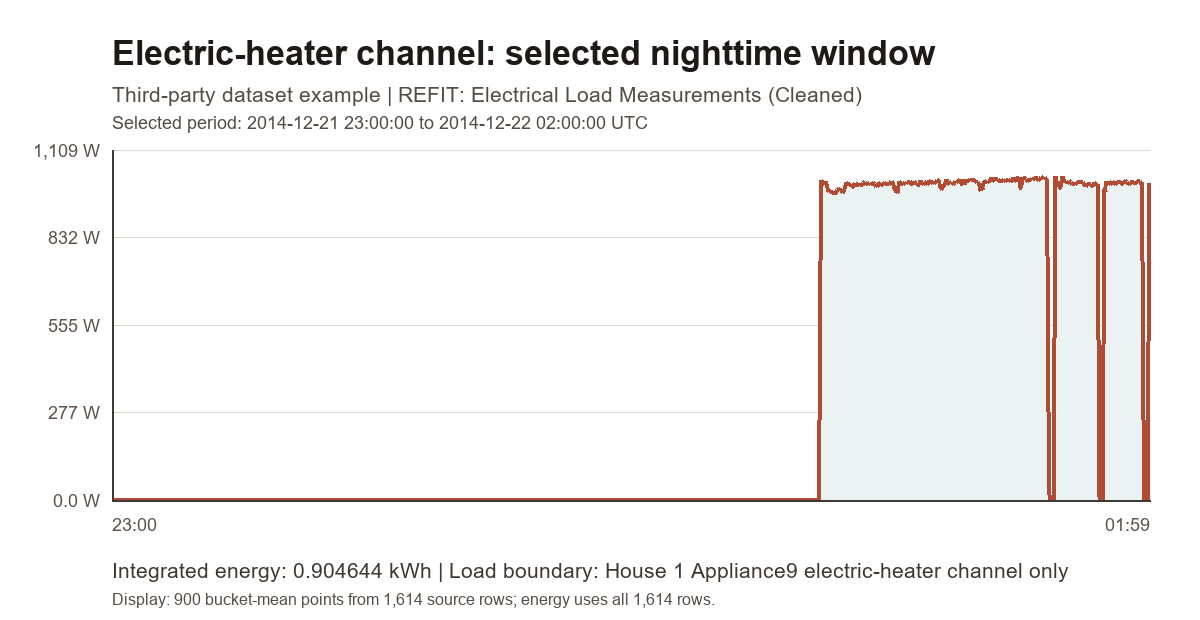
Applying each heater reading until the next timestamp, then holding the final 01:59:54 reading for six seconds to the declared 02:00 endpoint, gives sum(power x seconds) / 3,600,000 = 0.904644 kWh. The channel ranges from 1 W to 1,027 W and is above 100 W for 3,234 seconds under this integration method, or 53 minutes 54 seconds. That threshold is an analysis choice, not a verified thermostat-on signal. Multiplying the maximum 1.027 kW by all three clock hours would give 3.081 kWh, more than three times the integrated result. That is why a bounded kWh reading is stronger than treating a cycling heater's highest observed draw as continuous.
At the separate illustrative rate of 0.217 per kWh, the bounded result costs approximately 0.196308, or about 0.20, using the unrounded integrated kWh. Keep that cost attached to the selected three-hour interval instead of comparing it with the two-setting worksheet above as if the conditions matched.
Why this is not a typical heater night
The dataset does not record room conditions, thermostat setting, or occupant intent. REFIT also warns that monitor assignments could change. Its cleaned-data documentation describes forward-filled gaps and values replaced with zero, without a row-level imputation marker in this CSV. Low readings alone therefore do not prove that the heater was physically off. The useful lesson is the gap between maximum draw and integrated kWh, not a claim about normal heater use.
A meter's wattage rating does not override a heater's direct-to-wall connection instructions. Do not insert a smart plug, meter, power strip, or extension cord where those instructions prohibit it. Use the label-based estimate or an appropriate professionally installed monitoring system instead. The measurement guide covers compatibility checks.
Decide whether another session matches
Repeat the 3.700 kWh worksheet only when the room, heater settings, active-time record, and stopping point are close enough to represent the same pattern. Twelve matching attended sessions would be 3.700 x 12 = 44.400 kWh and about 9.63 at the illustrative rate. A different room or thermostat pattern deserves a separate row in your notes.
- Record the date, room, start and stop times, and setting changes.
- Use labeled wattage only for the time that setting was actually active.
- Keep a measured-kWh result separate from a wattage-based estimate.
- Compare the full bill separately rather than assigning every charge to the heater.
Run the calculation with your own record
For a label-based session, enter one setting at a time in the Appliance Electricity Cost Calculator and add the kWh or costs. For a meter reading, use the kWh to Cost Calculator. If the household total is still the question, take the session result to the bill-difference guide without treating it as the full bill.