Two complete paths for one cooling question
Path A is an illustrative calculation, not a measurement from a real air conditioner. Path B uses a three-hour interval from a published third-party household dataset. The labels keep an estimated input separate from a dataset-derived energy interval and show where each conclusion stops.
Path A: rated input and estimated active cooling time
Suppose a unit lists an illustrative 920 W input. During a selected six-hour afternoon block, your notes support 3.4 hours of active cooling rather than six continuous hours. The energy estimate is 920 / 1,000 x 3.4 = 3.128 kWh. At an illustrative rate of 0.214 per kWh, the usage cost is 3.128 x 0.214 = 0.669392, or about 0.67 after final display rounding.
This path depends heavily on the active-time estimate. If 3.4 hours came from a guess rather than a timer, controller log, or repeated observation, record that limitation with the result. Rated input can also differ from actual draw as the unit changes output.
Use electrical input watts, not the unit's cooling-capacity rating. This example prices only the assumed active-cooling draw; any fan-only or standby energy during the other 2.6 hours is excluded. For a variable-output unit, rated watts multiplied by active time may still misstate energy, so prefer kWh covering the whole block.
Path B: third-party measured AC interval
Third-party dataset example. In the Plegma clean dataset, House 1 metadata maps
ac_1 to the living-room air conditioner. From July 27, 2022 at 16:00:00 through 18:59:50
(timestamps recorded as UTC+3), the file contains 1,080 readings at 10-second intervals. Summing each active-power
reading across its 10-second interval, including the final interval ending at 19:00:00, gives
2.554075 kWh after rounding. This is calculated from power samples, not a cumulative kWh display;
the cost calculation retains the unrounded integrated value.
Practical Calculator Guide did not measure this household or air conditioner.
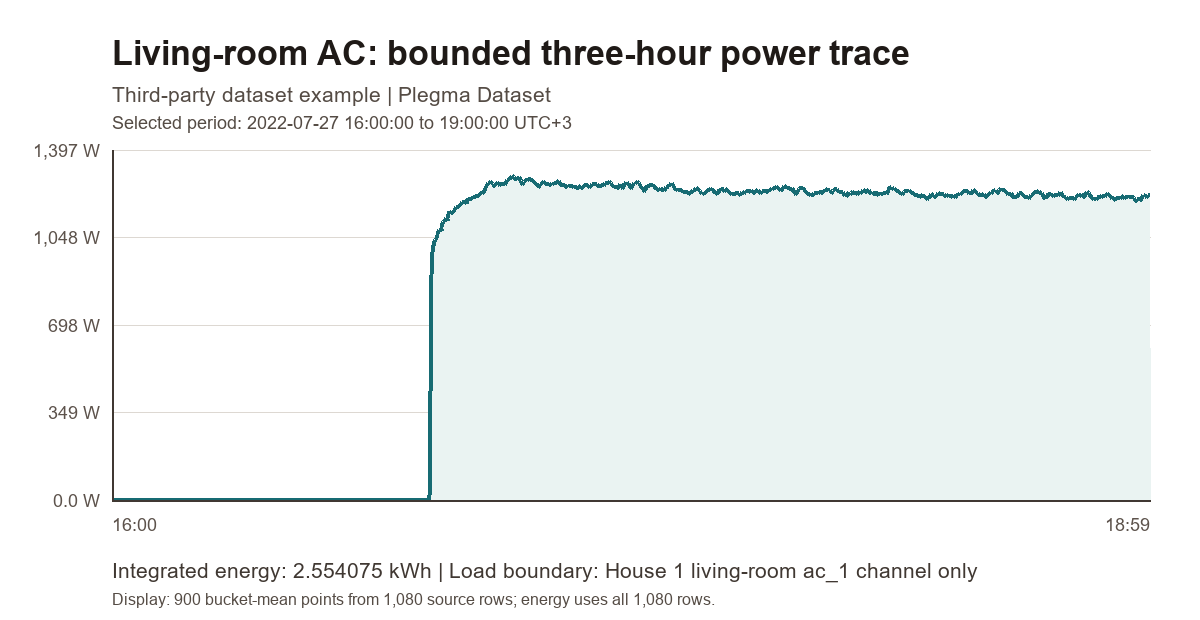
At the separate illustrative rate of 0.214 per kWh, 2.554075 x 0.214 is approximately 0.546572, or
about 0.55. The calculation includes only the living-room ac_1 channel. It excludes
the whole-home aggregate and the bedroom ac_2 channel, which used 2.352249 kWh during the same window.
What this interval changes in the decision
The interval supports pricing measured kWh instead of guessing active cooling time. It does not support an efficiency or thermostat claim: the bedroom unit was also drawing power, the thermostat setting and mode are unknown, and Plegma can forward-fill source gaps of up to 30 seconds without a row-level marker. Treat it as one bounded cleaned-data observation, not a controlled performance test.
Why the two example results are not a performance comparison
Path A uses an invented input and active-time assumption; Path B observes a different unit and does not identify its thermostat setting or operating mode. Their results therefore cannot show that one method or setting saved money. To compare cooling conditions, measure two periods in the same room, include the same appliance channel, and state the one condition that changed.
- Keep stable: room or zone, duration, and the appliance channel included in the reading.
- Change deliberately: one setting, schedule, or condition you want to compare.
- Record: date, start and stop times, setting or mode, and a short weather note.
- Conclude narrowly: state what happened in the measured time windows, not what every month will cost.
Choose the path from the strongest input
Use rated input only when it describes the mode you are evaluating and you can support active cooling time. Use measured kWh when its source and period match the cooling question. Annual kWh from an energy label is a third option for an annual question; do not divide it into a daily claim unless that average is useful and clearly labeled as an average.
Enter a short rated-input comparison in the Electricity Cost per Hour Calculator, or use the Appliance Electricity Cost Calculator when you have a defensible repeated schedule. Price a complete meter period with the kWh to Cost Calculator.
Keep the household bill as a separate question
A cooling-use result does not include other appliances or every charge on an electricity bill. When the goal is to explain a change in the total, keep the cooling record and compare it with the rest of the bill using the bill-difference guide.